Send Us Your Inquiry
Get a quick response from our team. Please fill in the form below with your product requirements, target quantity, and market details — we will reply within 24 hours with tailored OEM/ODM solutions for your brand.
For kitchen appliance brands looking to expand their product lines, the choice between sourcing from a trading company and partnering directly with an OEM/ODM manufacturer can determine your success in the market. Direct manufacturing partnerships offer greater control over quality, pricing flexibility, and faster response times for customization requests.
When you work directly with an OEM/ODM range hood manufacturer, you gain access to the entire product development process. From initial design concepts to final production, you can specify every detail: motor type, airflow capacity, control panel design, materials, finishes, and even packaging.
This level of control is especially valuable for brands that want to differentiate themselves in competitive markets. Instead of offering the same generic products as every other seller, you can create signature designs that build brand recognition .
Manufacturers that control the entire production chain—from metal fabrication to final assembly—achieve significant cost savings. These savings get passed on to you through competitive pricing, even at relatively low volumes.
A vertically integrated factory typically handles sheet metal cutting, stamping, bending, welding, painting, motor assembly, and final testing under one roof. This eliminates the markup and coordination issues that come with relying on multiple subcontractors .
Modern OEM/ODM suppliers recognize that brands need flexibility. Many now support sample orders as small as 10–20 units, allowing you to test market response before committing to large production runs. Once validated, production can scale to meet growing demand—monthly capacities of 200,000 to 350,000 units are common among established manufacturers .
The premium range hood market is expanding in developed regions, driven by consumer preference for open-plan kitchens and functional home spaces. Brands targeting these markets should prioritize high suction power (13+ m³/min), low noise levels (≤59 dB), and sleek designs with materials like stainless steel and tempered glass. European buyers also emphasize energy efficiency and minimal noise operation.
High-heat cooking traditions make powerful range hoods a necessity. These markets often prefer wider hoods (900mm+), stronger motors, and extraction capacities capable of handling intense smoke. Pricing remains a significant factor, making cost-effective Chinese manufacturing particularly attractive.
The Australian market ranks highly for performance demands. Australian consumers prioritize suction power and filter efficiency, often exceeding standards found in comparable markets.
The most popular style globally, these hoods mount directly to the wall above the cooktop. They come in various designs including T-shaped, curved glass, and sleek stainless steel profiles. Wall-mounted range hoods typically offer airflow rates of 11–13 m³/min and work well in most residential kitchens.
These compact units install beneath kitchen cabinets, making them ideal for kitchens where space is limited. Modern under-cabinet models achieve airflow performance comparable to larger units while offering a minimalist appearance with installation heights as low as 130mm.
Designed for kitchens that prioritize clean sight lines, pull-out range hoods retract when not in use and extend over the cooktop when needed. These models offer flexible installation with performance equivalent to fixed units while maintaining a clutter-free aesthetic.
Side-draft range hoods sit flush against the wall, pulling smoke horizontally rather than vertically. This design allows installation directly behind the cooktop with minimal overhead clearance, making them perfect for open-plan kitchens and island installations.
Guangdong province—particularly the cities of Zhongshan, Foshan, and Dongguan—has emerged as the global center for kitchen appliance manufacturing. Here’s why brands are increasingly sourcing from this region:
The region offers everything you need for range hood production: steel suppliers, glass fabricators, motor manufacturers, control board developers, packaging printers, and logistics providers—all within a few kilometers .
Years of specialization have created a deep pool of skilled labor, from metal workers to electrical engineers. This experience translates into consistent product quality, faster problem-solving, and shorter lead times .
Proximity to major ports like Shenzhen and Guangzhou simplifies shipping, while established export expertise ensures smooth customs clearance and documentation for overseas customers.
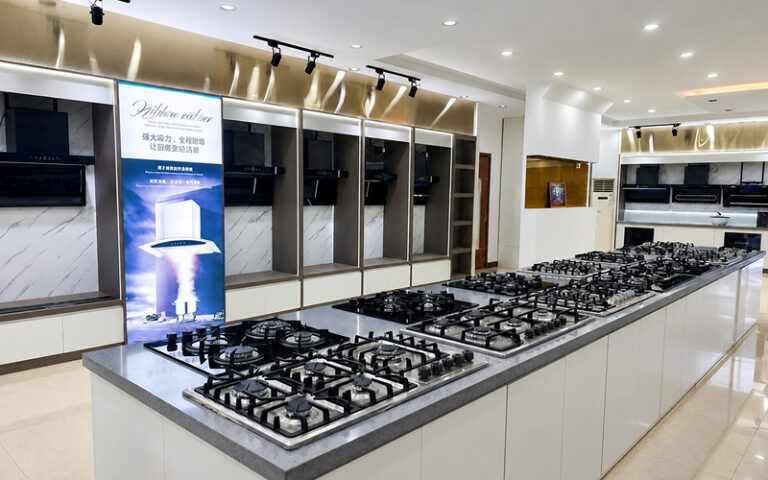
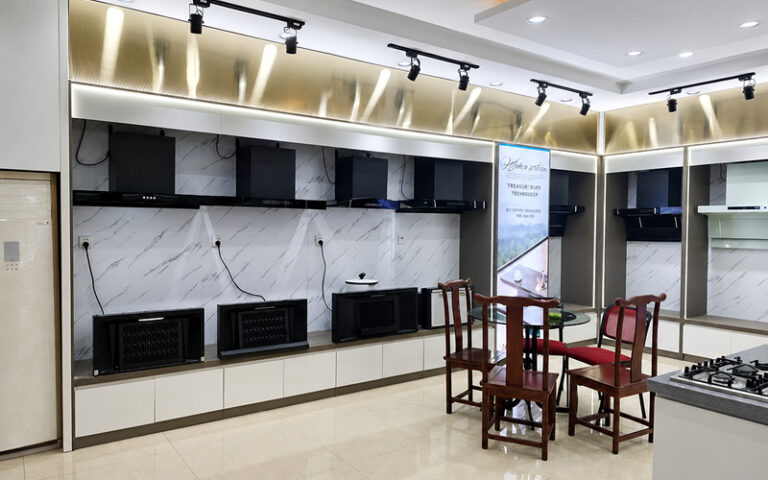
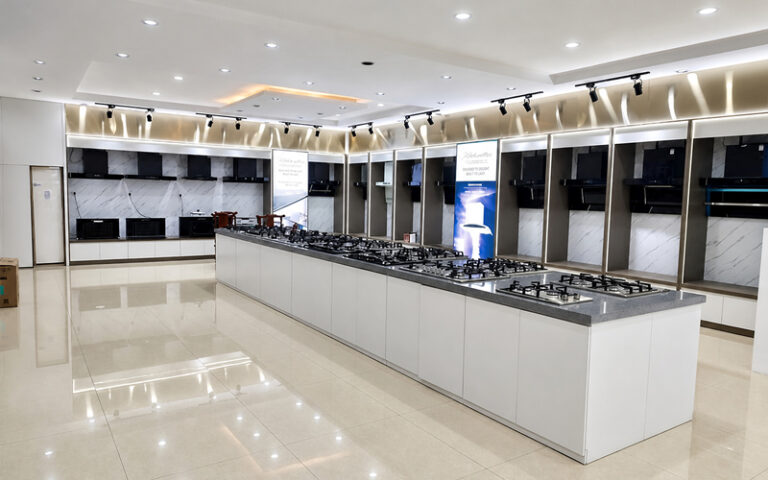
Visit the factory or request a video tour to see their production floor. A 25,000m² facility with dedicated assembly lines, in-house testing labs, and a showroom indicates serious manufacturing capability. Check for in-house processes like laser cutting, stamping, bending, and welding.
Ask for proof of previous exports to your target markets. Documentation such as shipping records, customs declarations, and certificates specific to your region provide evidence of their ability to meet regional safety standards (CE for Europe, UL for USA, SASO for Saudi Arabia).
A range hood manufacturer supporting sample orders, small trial runs, and volume production—without imposing high MOQs—is ideal for both new brands launching their first product and established brands testing new designs. When a partner offers end-to-end support from branding and packaging customization to control system adaptation and gas version configurations, you can focus on market growth while they handle the manufacturing complexities.
| Consideration | Why It Matters |
|---|---|
| Vertically integrated manufacturer | Better quality control, shorter lead times |
| In-house metal fabrication | Consistent structural quality, faster customization |
| Flexible MOQ | Lower risk when testing new markets |
| Export experience | Smooth customs, compliant products |
| OEM/ODM support | Unique products, brand differentiation |
Range hoods represent a significant opportunity for kitchen appliance brands. With the right OEM/ODM manufacturing partner, you can bring distinctive, high-quality products to market faster and more cost-effectively than ever before. The key is finding a partner with the capabilities, experience, and flexibility to grow with your brand.
By focusing on vertical integration, in-house metal fabrication, comprehensive export experience, and small-order support, you can build a range hood line that stands out in the market and drives lasting customer satisfaction.